
America’s Industrial Future: Reindustrialization in 2026 – Webinar
In an Industrial Supply Chain Forum webinar, experts explored how reindustrialization is evolving in 2026 and what it means for small businesses and their workers.
Where U.S. Manufacturing Stands Entering 2026
The current manufacturing environment in the U.S. has been steady but is losing momentum. Workforce shortages, supply chain capacity constraints, and policy uncertainty have constrained growth. A central theme of the discussion was that reindustrialization is not about restoring the past, but about upgrading for the future. Today’s manufacturing is driven by higher-skill, digitally enabled production—rather than a return to lower-wage roles that have moved offshore.
Industrial Policy: Momentum, but Limited Durability
Panelists described Biden-era industrial policies—the Infrastructure Investment and Jobs Act, the Inflation Reduction Act, and the CHIPS and Science Act—as historic catalysts for private investment and domestic industrial growth. Under the Trump administration, U.S. industrial policy have shifted, with a greater emphasis on trade policy, tariffs, and tax provisions. Despite these changes, panelists noted meaningful continuity in strategic priorities—particularly in semiconductors and pharmaceuticals—driven by national security concerns and supply chain vulnerabilities.
A core critique emerged: the United States lacks a formal, written industrial strategy comparable to peer industrial economies. This absence of a durable roadmap contributes to policy fragmentation and volatility across administrations. Panelists emphasized that a clear national strategy is essential to reduce uncertainty and guide long-horizon investment decisions.
Manufacturing Output Does Not Equal Employment
Even as manufacturing output expands, employment is not expected to increase proportionally due to automation, capital intensity, and global competition. As a result, local economic development strategies must extend beyond the factory floor to manufacturing-anchored services and complementary job creation. Panelists emphasized that these roles should be designed as career pathways, requiring alignment with community colleges, workforce intermediaries, and credentialing systems to support upward mobility.
States as the Critical Implementers: “People, Permits, Power”
Amid changes at the Federal level, State governments will be pivotal actors to “close the deal” by aligning and executing across systems:
People: Workforce and business development pipelines via community colleges, universities, sector strategies
Permits: Coordinated, accelerated approvals across agencies and jurisdictions
Power: Energy and infrastructure readiness (plus broadband and utility coordination)
States also serve as conveners that reduce fragmentation—creating a “front door” for investors and fostering collaboration across cities and regions in their jurisdiction.
Implications for Small Businesses
Reindustrialization requires rebuilding supply chains, not just constructing anchor facilities. When manufacturing moved offshore, supplier networks followed; now, small and midsize businesses are essential to rebuilding domestic capacity in inputs, components, packaging, logistics, maintenance, and specialized services. This creates opportunity—but only if small and mid-sized firms can access the capital, talent, and business development support they need to meet the moment.
A special thank you to our panel of experts:
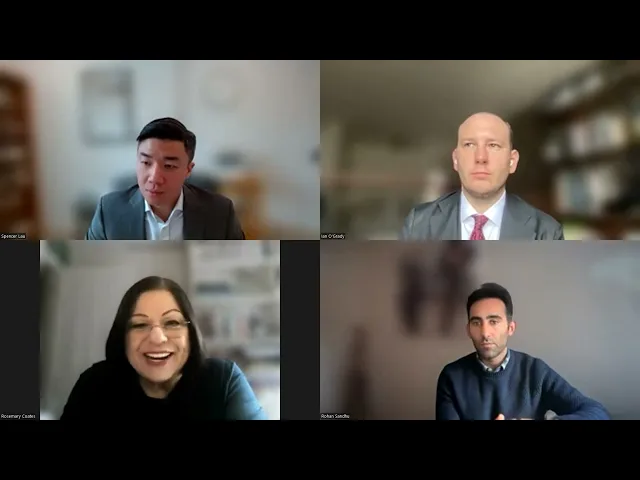
Rosemary Coates, Executive Director of the Reshoring Institute and President of Blue Silk Consulting
Ian O’Grady, Senior Policy Advisor to Governor Katie Hobbs of Arizona
Rohan Sandhu, Director and Co-Founder, Reimagining the Economy, Harvard Kennedy School
Spencer Lau, Head of Industrial Supply Chain Forum and Senior Director at Next Street (Moderator)
***
Interested in partnering to advance industrial supply chains and small business growth? Contact Andi Crawford or Spencer Lau.
Similar Blogs
News, Voices & Impact
Explore updates, field notes, and stories that showcase our mission and impact.